
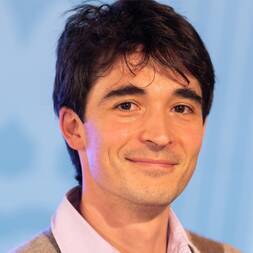
Daniele De Martino
Biography
Ikerbasque Research Fellow, Biofisika Institute (CSIC-UPV/EHU), Leioa, Spain
WEBSITE: https://www.ikerbasque.net/en/daniele-de-martino.
Daniele De Martino is an Ikerbasque research fellow at the Biofisika Institute (Leioa) where he is co-leading the theoretical biophysics group. His research interest focuses on the application of statistical physics methods to study quantitatively cellular interactions, in particular in the context of metabolism. He took a PhD in Statistical Physics at SISSA/ISAS (Trieste), and he has been working as a post-doctoral researcher with the Chimera group at the University of Rome, IST Austria, and Jozef Stefan Institute (Slovenia).
Feedback Ising models neural networks dynamics
Spin-spiking models analyzed with statistical mechanics play an important role to bridge cellular and macroscopic scales for understanding biological network dynamics (Amit 1992) and the associated inverse and inference problems are used to resolve the real network topologies (Shneidemann et al 2006). One caveat of this approach is the simplifying equilibrium hypothesis, that is unable to reproduce stylized dynamical behaviors like oscillations. In this talk, I will discuss classical lattice models in presence of a feedback between order and control parameters. In presence of the latter, out-of-equilibrium phase transitions triggering collective self-oscillations takes over equilibrium critical points. I will focus on the fully connected feedback Ising model and its capacity to quantitatively model statistical features brain waves, in particular the elusive coexistence of oscillations and avalanches. Feedback models inherit the analytical tractability of their equilibrium counterpart that makes it possible fast and reliable inference calculations. I will conclude discussing the extension of the feedback scheme to the Tricritical Ising and Potts models leading to higher order bifurcation points and chaos.