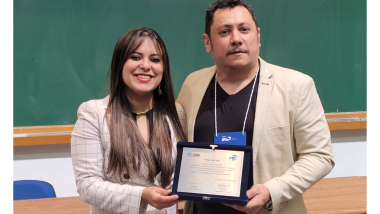
Imanol Gago will defend his thesis on Wednesday, December 17th
- The defence will take place at Sala Adela Moyua, Faculty of Science and Technology (EHU-Leioa) at 10:45
Imanol Gago Carro (Bilbao, 1992) has always had a strong interest and curiosity in mathematics, so it came as no surprise that he decided to pursue a degree in the field. He graduated in Mathematics from the University of the Basque Country in 2014, spending one academic year in Madrid. Moreover, he completed a master’s degree in Mathematical Engineering at the Complutense University of Madrid in 2016. After gaining experience in private companies and public institutions, in 2019 he joined the Combinatorial Optimization (CO) research line at the Basque Center for Applied Mathematics (BCAM). In 2021, he began his doctoral studies in the Mathematics and Statistics programme at the University of the Basque Country. He is currently working as a Statistical Technician at Eustat, the Basque Institute of Statistics. Regarding his personal interests, he enjoys getting lost while running in the mountains, playing board games with friends, and going to the cinema to watch newly released films
His thesis, titled “Optimization under uncertainty for ambulance location-allocation" is supervised by Unai Aldasoro Marcellan (EHU) and María Merino Maestre (BCAM-EHU). It is scheduled to be defended on December 17th, 2025, at Sala Adela Moyua, Faculty of Science and Technology (EHU - Leioa) at 10:45 a.m.
On behalf of all members of BCAM, we would like to wish him all the best for the future, both professionally and personally.
Abstract
This thesis studies the strategic planning of Emergency Medical Services (EMS) by modeling the location and allocation of ambulances under conditions of uncertainty and with multiple objectives. Using the Basque public EMS as a real-world case study, we utilize historical databases to model the uncertainty that is gradually introduced into the proposed models. In this way, we estimate stochastic travel times using adjusted distributions (in particular, BCCG), with a clustering process and GAM. As a first model, we propose a two-stage 0-1 stochastic MILP to evaluate relocation and expansion policies, balancing overall efficiency and equity between regions. The model incorporates spatiotemporal uncertainty of emergencies and a response time penalty at various intervals. Second, we formulate a hierarchical compromise model: first, coverage is maximized, and then the average response time, resource adequacy, and equity (using CVaR) are jointly improved. To address large-scale cases, we extend the Branch-and-Fix Coordination matheuristic to handle constraints between scenarios. This model incorporates a new uncertain component: ambulance travel times. Third, we develop a distributionally robust optimization framework to protect against poorly specified travel time distributions and compare it with stochastic and robust optimization. A discrete-event simulation model shows that DRO solutions better align design and operation. Overall, the thesis bridges the gap between theory and practice by using realistic data, scalable algorithms, and rigorous validation.
Related news
Eventos, Sobre el centro
Segunda edición del Encuentro de Dinámica de Fluidos Matemática celebrado en BCAM