DSABNS 2026 reinforces its international leadership in dynamical systems applied to biology and natural sciences
-
Granada hosted the 17th edition of a well-established international scientific conference founded in 2010, organized by the MTB group at BCAM, in collaboration with colleagues from the NOVA School of Science and Technology, Portuguese faculty of the NOVA University Lisbon (NOVA FCT).
-
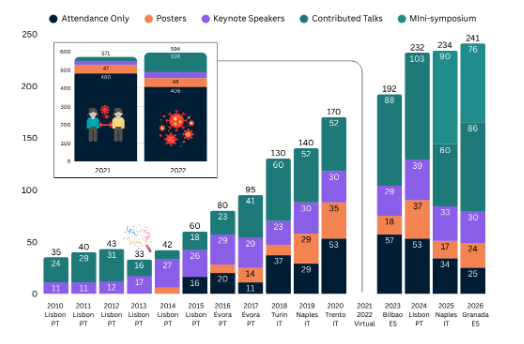
The interdisciplinary program featured an Honorary Lecture, 30 Keynote speakers, Plenary and Invited lectures, 15 Minisymposia, Parallel Sessions with contributed talks on population dynamics, eco-epidemiology, infectious disease epidemiology, molecular evolution, and mathematical methods, as well as Poster Presentations, all compiled in a book of abstracts with ISBN.
-
240 researchers attended 30 high-impact keynotes and 15 minisymposia, with a special tribute honoring Prof. Ezio Venturino’s decades of scientific leadership.
The 17th International Conference on Dynamical Systems Applied to Biology and Natural Sciences (DSABNS 2026) took place at the Hotel Macià Real de La Alhambra, in Granada, Spain, from February 2–6, 2026. The event concluded with resounding success, further consolidating its position as one of the most relevant international scientific meetings at the intersection of mathematics, biology, and the natural sciences. The event was organized by the MTB group at BCAM, in collaboration with colleagues from the NOVA School of Science and Technology, Portuguese faculty of the NOVA University Lisbon (NOVA FCT).
Since its inception in 2010, DSABNS has been organized annually in February, establishing itself as a well-established international scientific event and a key reference point for researchers working on dynamical systems applied to biological and natural phenomena.
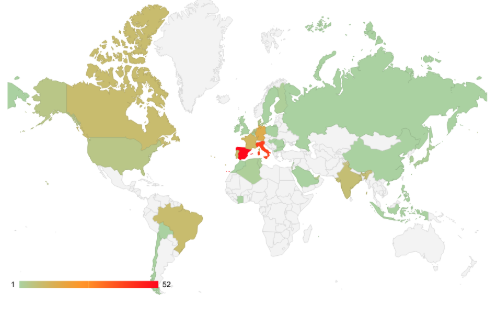
This year’s edition brought together 240 researchers, academics, and professionals from around the world,
confirming the growing global interest in dynamical systems applied to biological, ecological, and epidemiological challenges.
A comprehensive and interdisciplinary scientific program
The conference program was designed to offer a diverse and enriching experience, covering research areas such as population dynamics, eco-epidemiology, infectious disease epidemiology, molecular and antigenic evolution, and methodological advances in mathematics and the natural sciences.
The program structure reflected the conference’s commitment to scientific excellence and interdisciplinarity. It included:
-
Honorary Lecture by Prof. Carlos A. Braumann, Évora University, Portugal, titled “Living in random environments”
-
Plenary Lectures, scheduled to open and close the scientific program, featuring distinguished experts delivering keynote talks in both morning and afternoon sessions.
-
Invited Lectures, offering broader perspectives and context for the parallel sessions.
-
Parallel Sessions with Contributed Talks, creating a stimulating environment for participants to present their research and foster new collaborations.
-
A limited number of Minisymposia, each consisting of 4–5 talks, allowing in-depth exploration of complex or emerging topics.
-
A dynamic Poster Session, enabling researchers to present their work visually and engage in direct scientific discussion with peers.
The scientific contributions presented during the conference are compiled in a Book of Abstracts with ISBN, published at the end of the event, ensuring the dissemination and long-term accessibility of the research shared at DSABNS 2026.
High-Impact Keynote and Plenary Lectures
One of the key pillars of this edition’s success was the outstanding quality of its keynote and plenary speakers, who delivered lectures of high scientific impact and strong interdisciplinary projection.
The guest of honor was Prof. Carlos A. Braumann (Universidade de Évora), who delivered the lecture “Living in Random Environments.” An internationally recognized expert in stochastic differential equations applied to biological systems, and former President of the European Society for Mathematical and Theoretical Biology (EMSTB), his lecture emphasized the critical role of stochastic modeling in understanding biological and environmental systems under uncertainty.
The plenary speakers offered an overview of the most pressing challenges in mathematical epidemiology, population dynamics, complex systems, and neuroscience, addressing topics such as arbovirus emergence in non-endemic regions, spatial epidemic modeling, phylodynamics of avian influenza, microbiota–neuroinflammation links in Alzheimer’s disease, aggregation–diffusion equations for cell sorting, molecular adaptation, neural information theory, multiscale systems in mobility and energy, self-similarity in epidemiology, and stochastic population dynamics in heterogeneous environments.
Invited speakers from leading institutions across Europe, the Americas, Africa, and Asia further enriched the program, covering themes including identifiability in epidemic models, multi-strain dynamics, human behavior and imperfect vaccines, spatiotemporal pattern formation, invasive species spread, HIV modeling, delayed tumor dynamics, mass extinctions, and dengue spatiotemporal analysis.
A historic edition and a growing international community
The combination of scientific excellence, thematic diversity, innovative session formats, and broad international participation made DSABNS 2026 a historic edition.
Beyond the formal sessions, the conference fostered meaningful exchange between early-career researchers and established experts, generating new international collaborations and strengthening the global scientific community working on dynamical systems applied to biology and the natural sciences.
With 240 attendees and a program of exceptional scientific level, DSABNS 2026 reaffirms its position as a must-attend event in the international scientific calendar and sets a high standard for future editions.
DSABNS 2026 also paid tribute to the memory of Prof. Ezio Venturino (University of Torino, Italy), a foundational member of the DSABNS team since its inception.
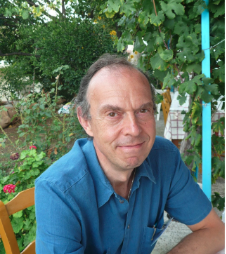
Prof. Venturino received his Ph.D. in Applied Mathematics from the State University of New York at Stony Brook in 1984 and served as Professor of Mathematics at the Dipartimento di Matematica, University of Torino. He was a passionate and internationally respected researcher in nonlinear dynamical systems, particularly in biological and ecological applications. Earlier in his career, his research focused on numerical analysis, especially methods for integral equations.
His scientific vision, commitment to interdisciplinarity, and generous spirit were instrumental in shaping DSABNS into the vibrant and supportive scientific community it is today.
He leaves behind an extraordinary legacy of scholarship, mentorship, and friendship. The DSABNS community continues to honor his memory through scientific rigor, collaboration, and collegiality — values he championed throughout his life and career.
He will be deeply missed and remembered with great respect and affection.
Related news

About the center, BCAM people
BCAM, EHU and ELHUYAR bring the science of sound to stages across the Basque Country
Research, BCAM people
BCAM and Forschungszentrum Jülich study pedestrian movement in Bilbao's Old Town