More than one hundred students from Pagasarribide LHI (Bilbao) visit BCAM to take part in the OREskolak educational programme, part of the MSCA & Citizen project ‘ORE4CITIZENS’
- Students became turbine detectives guided by Ana Fernández Navamuel, Principal Investigator of the project, discovering how science, technology and mathematics help us take care of our energy giants.
- The ORE4Citizens consortium is a European project (Horizon Europe) led by TECNALIA, Euskampus, the University of the Basque Country (EHU) and BCAM. Its aim is to bring science and research in offshore renewable energy (ORE) closer to the public, especially young people and educators, through practical activities and workshops during events such as European Researchers' Night, promoting STEM careers and inclusion.
More than one hundred 5th and 6th grade students from Pagasarribide LHI (Bilbao) visited BCAM in December to participate in OREskolak, the educational programme of the MSCA & Citizen project ORE4CITIZENS, which aims to bring research in offshore renewable energies closer to school communities.
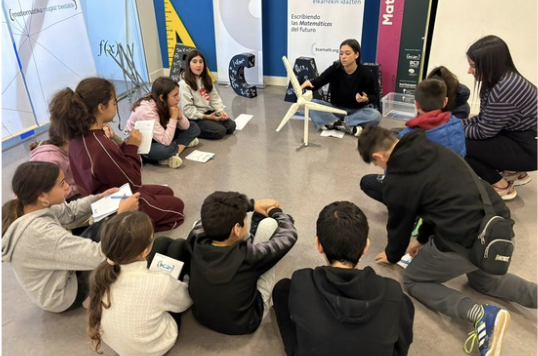
Guided by Ana Fernández Navamuel, four classes from the school became “Turbine Detectives”. With the support of BCAM researcher Elisabetta de Giovanni, Ana led the aspiring detectives as they searched for possible faults that these offshore giants might have developed, preventing them from operating at full capacity.
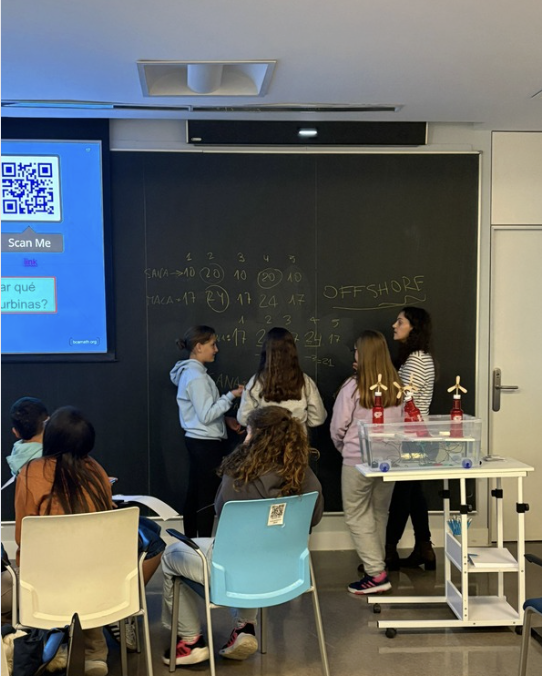
Participants spent a morning exploring how offshore wind turbines can also suffer from hidden “injuries”. Through examples and hands-on activities with mathematics at the centre, they learned that these structures—located hundreds of kilometres offshore and exposed to extreme conditions—require continuous monitoring to detect any issue before it becomes critical.
During the workshop, the students took control of the investigation through three phases:
- Experimenting: stepping into the shoes of an engineer working with floating turbine simulators.
- Inspecting: analysing groups of turbines, several of which presented a hidden malfunction.
- Diagnosing: using observation and mathematical problem-solving to identify the origin of the issue—ranging from excess weight caused by marine organisms to loose components or broken mooring systems.
Through this experience, the participants discovered in an engaging and accessible way how science, technology and mathematics help maintain these large generators of clean energy. They also understood how small variations—such as slight vibrations or barely noticeable tilting—can be key to preventing major failures.
The activity concluded with a “Who’s Who” game about marine-related professions and with the opportunity to assemble a scale wind turbine model, reinforcing hands-on learning and fostering interest in STEM vocations.
With initiatives like OREskolak, the MSCA & Citizen programme helps students of all ages understand the real impact of research on their daily lives and promotes a society more connected to science and innovation.
The ORE4Citizens consortium is a European project (Horizon Europe) led by TECNALIA, Euskampus, the University of the Basque Country (EHU) and BCAM. Its aim is to bring science and research in offshore renewable energy (ORE) closer to the public, especially young people and educators, through practical activities and workshops during events such as European Researchers' Night, promoting STEM careers and inclusion.
Related news